Comment fonctionnent les chargeurs pour véhicules électriques ?
At its most basic, an EV charger pulls an electrical current from either a 240v outlet or the grid it’s hardwired to and delivers that electricity to the vehicle, just like any other appliance or device you charge by plugging into the wall.
One of the biggest concerns for electric vehicle (EV) owners is knowing when and how to charge their vehicle. It makes sense: The average American has spent their life driving around in gas-powered cars, filling up at one of the hundreds of thousands of gas stations as the gauge creeps towards empty. Charging one’s EV takes a little more planning, but with the growing demand and incentives for alternatives to gas-powered cars, public EV charging stations are becoming a more common sight.
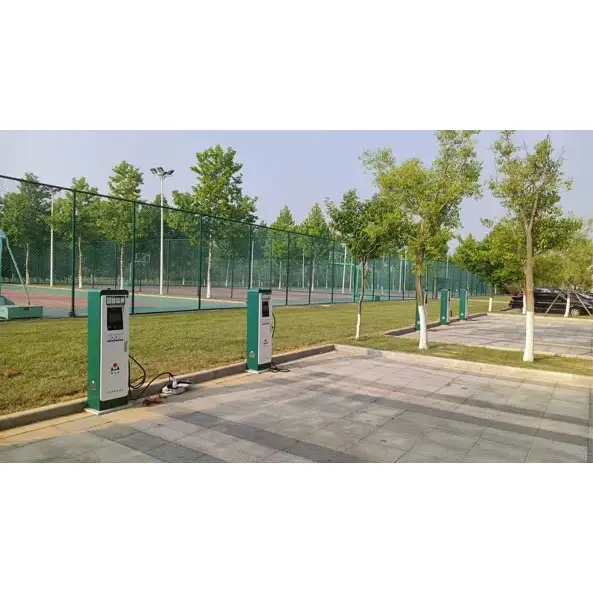
So whether you’re the owner of an EV or looking to add a public EV charging station to your commercial property, here are just a few things you should know about how an EV charger works.
Qu’est-ce qu’un chargeur pour véhicules électriques ?
Les véhicules électriques et les véhicules hybrides rechargeables nécessitent un chargeur pour maintenir la batterie pleine, comme tout appareil ou dispositif rechargeable.
Every Charger Won’t Necessarily Plug to Every EV—But Adaptors Are Available
For the most part, a J1772 plug is standard for EVs—that is, unless you have a Tesla or are trying to use a Tesla EV charging station. Think of it as a device charging cord: If you have a USB-C cord, but your device takes Mini-USB, the USB-C cord can’t be used to charge your device without an adaptor.
Parce que Tesla utilise son propre type de connecteur entre le dispositif et le véhicule, un chargeur Tesla ne peut pas être utilisé sur un véhicule non Tesla, et un chargeur non Tesla ne peut pas être utilisé sur un véhicule Tesla sans adaptateur.
Adaptors do exist and can be purchased online, but it’s important for drivers to note what type of charger they’re parking in front of. Additionally, commercial entities that want to provide EV charging on their property or parking lots should take into consideration that buying only Tesla chargers will leave many EV drivers unable to use your services.
Comment fonctionnent les stations de recharge publiques pour véhicules électriques ?
If you are parking in front of an EV charging station, there are a few things you’ll need to determine. For one, the station may be provided free of charge, may require a key FOB or other access device, or it may require credit card payment—similar to other parking situations such as only being allowed to park in a lot for free if you’re a customer, or you may need to pay a parking meter during specific times and on specific days. The device and posted notices should make it clear how to use the charging station.
For organizations looking to add public EV charging stations to their property, EvoCharge’s iEVSE and iEVSE Plus vous offrent des options quant à l’utilisation de votre chargeur par d’autres. Les deux unités permettent de contrôler la puissance de sortie et les temps de recharge, et l’iEVSE Plus dispose de fonctionnalités 4G LTE et de lecteur de cartes RFID pour générer des revenus grâce au chargeur.